

Common Furniture Buying Mistakes [And How to Avoid Them]
Buying furniture is rarely as straightforward as it looks. A piece that seems right in a showroom or online can quickly become a problem once it's in the room, taking up more space than expected, failing to store what you need, or making the layout harder to use. These issues rarely come down to poor taste. More often, they're the result of a few avoidable decisions made early in the buying process.
This guide covers the most common furniture buying mistakes and explains how to avoid them. From skipping accurate measurements to underestimating storage needs and choosing designs that overwhelm a space, understanding where things tend to go wrong makes it much easier to choose furniture that works well from the start.

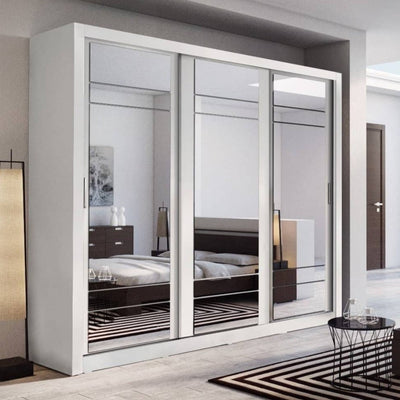
[Arti 18 - 2 Sliding Door Wardrobe 150cm]
1. Skipping Accurate Measurements
One of the most costly furniture mistakes happens before anything is even ordered. A piece that looks right in a product image can arrive and immediately create problems, blocking a doorway, leaving too little room to pull out a chair, or narrowing a hallway until it feels awkward to pass through. Of the many ways measurements are overlooked, clearance space is often the one that proves most frustrating in practice.
Clearance refers to the space a piece needs in order to function comfortably within the room. A sofa might sit neatly against a wall, yet still leave the layout feeling cramped if there is not enough room between it and the coffee table. A chest of drawers may technically fit in a corner, but become difficult to use if the drawers cannot open fully. Storage furniture is especially prone to this oversight, as attention often focuses on whether it fits the wall rather than how it functions day to day.
Fortunately, clearance issues are not complicated. They arise from a small number of overlooked details:
-
Door swing requirements
-
Drawer extension depth
-
Walking space around the unit
-
Reach and access around surrounding furniture
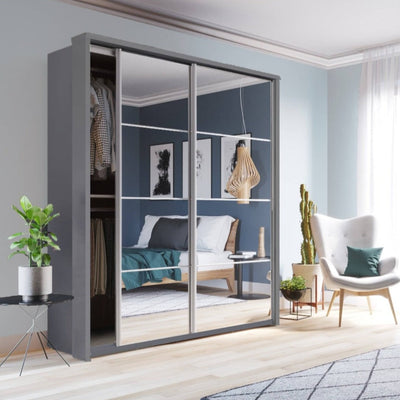
The Arti 18 - 2 Sliding Door Wardrobe 150cm demonstrates how this works in practice. Its sliding mechanism provides full interior access without extending into the room, eliminating the need to account for door swing. The mirrored surface adds a secondary benefit by reflecting light and visually opening the space. In tighter rooms, furniture designed with this level of spatial awareness makes a noticeable difference to how comfortable the layout feels.

[Modo Sideboard Cabinet 150cm]
2. Underestimating Future Storage Needs
While accurate measurements protect a room’s layout, long-term storage planning protects how that room functions over time. Storage is one of the easiest aspects to underestimate when buying furniture. It is tempting to choose a piece based solely on current needs, without considering how belongings may accumulate or routines may shift. A unit that feels adequate today could quickly become restrictive as circumstances change.
One common oversight is choosing larger storage pieces, such as sideboard cabinets, with a fixed internal layout. When shelves cannot be adjusted, when drawers are absent, or when compartments only suit one type of item, flexibility is reduced. As needs evolve, the unit may no longer align with how the space is used, gradually becoming restrictive rather than supportive.
To maintain long-term flexibility, certain structural features become particularly important:
-
Adjustable shelf positions
-
A mix of drawers and enclosed compartments
-
Internal divisions that separate different item types
-
Configurations that allow rearrangement over time
The Modo Sideboard Cabinet 150cm reflects this approach through its adaptable interior. Adjustable shelves allow items of different heights to be stored comfortably, while four drawers keep smaller belongings organised separately. As storage needs evolve, the unit adjusts alongside them rather than becoming a limitation. A piece that can do this from the start is far less likely to need replacing when circumstances shift.

[CP-01 Vertical Wall Bed Concept 140cm]
3. Choosing Bulky Designs
Even when furniture fits the room and provides adequate storage, it can still create problems if it occupies space inefficiently. Bulky pieces become restrictive not because of how they look, but because of what they fail to offer in return. A large item that serves only a single purpose permanently claims floor space without allowing the room to adapt around it. In smaller homes, spare rooms, and studio layouts, this is often what causes a space to feel limited rather than flexible. The area a piece occupies should be justified by what it contributes to the room, not simply by the fact that it fits.
A standard bed illustrates this clearly. It occupies a substantial portion of the floor regardless of whether it is being used. In a spare room or studio flat, this reduces the room’s ability to support other activities comfortably. When combined with a wardrobe and a desk, even a reasonably sized space can begin to feel fixed in purpose, not because any single piece is oversized, but because none of them return space when not in use.
Murphy Beds such as the CP-01 Vertical Wall Bed Concept 140cm demonstrate how this limitation can be addressed within the same footprint. By folding vertically against the wall during the day, it restores usable floor space and allows the room to function differently over time. Integrated storage units on either side reduce the need for additional furniture, while a spring mechanism, duvet holding straps, and a locking system maintain everyday comfort and practicality. In rooms that must support more than one activity, furniture designed with this level of adaptability helps the room adapt over time rather than remain locked into a single purpose.
Final Thoughts
Most furniture buying mistakes are not the result of poor judgement, but of small oversights that only become visible once a piece is in place. Clearance space, internal configuration, and how a unit affects the room when it is not in use all have a lasting impact on comfort and practicality. When these factors are considered early, the layout supports everyday life rather than working against it.
Choosing furniture with an awareness of space, flexibility, and everyday function helps decisions hold up as needs change. By approaching each purchase with a clear understanding of how the piece will live within the room, it becomes far easier to create spaces that feel organised, balanced, and comfortable over time.
Leave a comment